Greek govt seeks to tackle farmer protests after Crete clashes / Photo: Aris MESSINIS - AFP

 London
 14 °C
14 °C

 Manchester
 10 °C
10 °C
 Glasgow
12 °C
Glasgow
12 °C
 Dublin
11 °C
Dublin
11 °C
 Belfast
 9 °C
9 °C
 Washington
 8 °C
8 °C
 Denver
15 °C
Denver
15 °C
 Atlanta
 10 °C
10 °C
 Dallas
 14 °C
14 °C
 Houston Texas
18 °C
Houston Texas
18 °C
 New Orleans
18 °C
New Orleans
18 °C
 El Paso
22 °C
El Paso
22 °C
 Phoenix
23 °C
Phoenix
23 °C
 Los Angeles
17 °C
San Diego
19 °C
San Francisco
Los Angeles
17 °C
San Diego
19 °C
San Francisco
 15 °C
Chicago
12 °C
Minneapolis
10 °C
Seattle
8 °C
Portland
10 °C
Salt Lake City
14 °C
Las Vegas
21 °C
Miami
22 °C
Jacksonville
13 °C
San Antonio
17 °C
Bermuda
24 °C
Nassau
15 °C
Chicago
12 °C
Minneapolis
10 °C
Seattle
8 °C
Portland
10 °C
Salt Lake City
14 °C
Las Vegas
21 °C
Miami
22 °C
Jacksonville
13 °C
San Antonio
17 °C
Bermuda
24 °C
Nassau
 9 °C
Iqaluit
-9 °C
Yellowknife
-2 °C
Anchorage
-1 °C
Fairbanks
9 °C
Iqaluit
-9 °C
Yellowknife
-2 °C
Anchorage
-1 °C
Fairbanks
 -5 °C
Barrow
-4 °C
Calgary
8 °C
Edmonton
6 °C
Winnipeg
5 °C
Goose Bay
6 °C
Halifax
10 °C
Boston
8 °C
Ottawa
3 °C
Toronto
7 °C
Detroit
6 °C
Cleveland
5 °C
New York
10 °C
Baltimore
8 °C
Philadelphia
-5 °C
Barrow
-4 °C
Calgary
8 °C
Edmonton
6 °C
Winnipeg
5 °C
Goose Bay
6 °C
Halifax
10 °C
Boston
8 °C
Ottawa
3 °C
Toronto
7 °C
Detroit
6 °C
Cleveland
5 °C
New York
10 °C
Baltimore
8 °C
Philadelphia
 7 °C
Nuuk (Godthåb)
-7 °C
Hong Kong
28 °C
Singapore
30 °C
Melbourne
18 °C
Canberra
16 °C
Adelaide
26 °C
Darwin
29 °C
Perth
16 °C
Fort Worth
15 °C
Honolulu
7 °C
Nuuk (Godthåb)
-7 °C
Hong Kong
28 °C
Singapore
30 °C
Melbourne
18 °C
Canberra
16 °C
Adelaide
26 °C
Darwin
29 °C
Perth
16 °C
Fort Worth
15 °C
Honolulu
 24 °C
Sydney
18 °C
Johannesburg
27 °C
Dubai
37 °C
Mumbai
35 °C
Zürich
12 °C
Tokyo
18 °C
Seoul
9 °C
Delhi
31 °C
Beijing
12 °C
Riyadh
36 °C
Prague
12 °C
Pennsylvania
5 °C
Valletta
24 °C
Manama
35 °C
Warsaw
14 °C
Stockholm
12 °C
24 °C
Sydney
18 °C
Johannesburg
27 °C
Dubai
37 °C
Mumbai
35 °C
Zürich
12 °C
Tokyo
18 °C
Seoul
9 °C
Delhi
31 °C
Beijing
12 °C
Riyadh
36 °C
Prague
12 °C
Pennsylvania
5 °C
Valletta
24 °C
Manama
35 °C
Warsaw
14 °C
Stockholm
12 °C
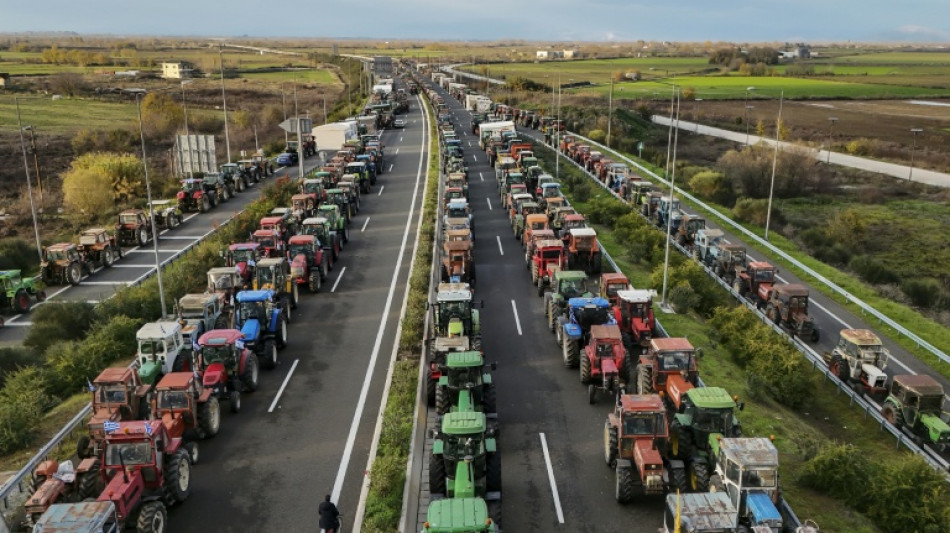
Greece's government was on Tuesday scrambling to keep angry farmers from blocking key infrastructure after airports were occupied on Crete in a growing nationwide protest for agriculture funds.
Thousands of tractors have intermittently blocked highways and border crossings since late November, and the farmers have vowed to block the central port of Volos on Wednesday.
"At this moment, there are over 20,000 tractors on the roads of Greece, possibly approaching 25,000," Sokratis Alifteiras, a senior farm unionist for the central Larissa region, told AFP.
"The decision made by the farmers of Thessaly for tomorrow morning is to block the port of Volos" from both land and sea, he said.
The conservative government of Kyriakos Mitsotakis has for months struggled to address a farm subsidy scandal investigated by EU authorities, which has resulted in payment delays to tens of thousands of growers.
The government has promised to allocate additional funds to legitimate farmers, who are under additional pressure this year owing to low prices for their produce, higher energy costs and a disastrous sheep pox epidemic.
"Produce prices are so humiliatingly low, that the cost of production is higher than the money we earn," Vaios Tsiakmakis, a tobacco and cotton grower told AFP at a protest near the central town of Karditsa.
On Monday, farmers on the island of Crete broke through police lines and occupied the main airports of Heraklion and Chania, forcing several flights to be cancelled or rescheduled.
Another farm protest on the island of Lesbos on Monday prevented passengers from leaving an outbound ferry.
The protest in Heraklion ended on Tuesday, while in Chania the farmers were seeking to meet with local officials before deciding on further action.
In May, EU prosecutors alleged that thousands of suspects -- many of them not farmers -- had for years made claims for land they did not own, and exaggerated livestock numbers.
Greek officials say more than 30 million euros ($35 million) of false claims were made.
The alleged graft is believed to have been ongoing at least since 2018, costing genuine farmers 70 million euros annually.
"The money never reached the farmers, those who stole should be in prison," said Costas Tsoukalas, another farmer at the Karditsa protest.
The government has vowed that no legitimate farmers will lose money and Prime Minister Kyriakos Mitsotakis on Monday insisted the government was open to dialogue with farmers' representatives.
He warned the protests could be detrimental to the farmers' cause.
"Sometimes, the most extreme mobilisations might turn large segments of society against the farmers, who may have legitimate demands," said the Greek leader, whose home island of Crete is strongly implicated in the scandal.
According to officials, the sector stands to receive 3.7 billion euros in subsidies this year, 600 million euros more than in 2024.
Approximately 80 percent of total subsidies granted from 2017 to 2020 for pastures ended up in Crete.
The scandal has already led to the resignation of one minister.
Farmers are also demanding compensation following the loss of over 400,000 sheep and goats in a sheep pox outbreak, all of which were slaughtered to stop the spread of the disease.
I.Ponce--HdM