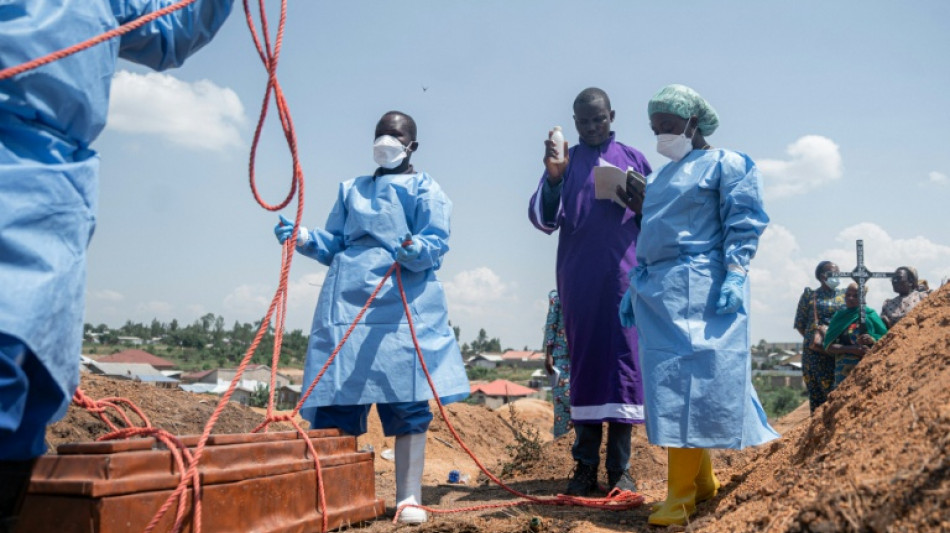
2,500 dead and rising -- UN says DR Congo Ebola outbreak 'growing exponentially' / Photo: Jospin Mwisha - AFP

 London
 20 °C
20 °C

 Manchester
 19 °C
19 °C
 Glasgow
21 °C
Glasgow
21 °C
 Dublin
16 °C
Dublin
16 °C
 Belfast
17 °C
Belfast
17 °C
 Washington
 19 °C
19 °C
 Denver
20 °C
Denver
20 °C
 Atlanta
23 °C
Atlanta
23 °C
 Dallas
29 °C
Dallas
29 °C
 Houston Texas
27 °C
Houston Texas
27 °C
 New Orleans
 28 °C
28 °C
 El Paso
25 °C
El Paso
25 °C
 Phoenix
32 °C
Phoenix
32 °C
 Los Angeles
21 °C
San Diego
Los Angeles
21 °C
San Diego
 21 °C
San Francisco
14 °C
Chicago
21 °C
San Francisco
14 °C
Chicago
 18 °C
Minneapolis
19 °C
Seattle
18 °C
Minneapolis
19 °C
Seattle
 15 °C
Portland
18 °C
Salt Lake City
25 °C
Las Vegas
33 °C
Miami
28 °C
Jacksonville
25 °C
San Antonio
25 °C
Bermuda
29 °C
Nassau
19 °C
Iqaluit
10 °C
Yellowknife
8 °C
Anchorage
15 °C
Portland
18 °C
Salt Lake City
25 °C
Las Vegas
33 °C
Miami
28 °C
Jacksonville
25 °C
San Antonio
25 °C
Bermuda
29 °C
Nassau
19 °C
Iqaluit
10 °C
Yellowknife
8 °C
Anchorage
 13 °C
Fairbanks
13 °C
Barrow
7 °C
Calgary
11 °C
Edmonton
20 °C
Winnipeg
15 °C
Goose Bay
16 °C
Halifax
19 °C
Boston
19 °C
Ottawa
16 °C
Toronto
16 °C
Detroit
19 °C
Cleveland
16 °C
New York
20 °C
Baltimore
19 °C
Philadelphia
19 °C
Nuuk (Godthåb)
10 °C
Hong Kong
29 °C
Singapore
29 °C
Melbourne
24 °C
Canberra
8 °C
Adelaide
12 °C
Darwin
26 °C
Perth
17 °C
Fort Worth
28 °C
Honolulu
13 °C
Fairbanks
13 °C
Barrow
7 °C
Calgary
11 °C
Edmonton
20 °C
Winnipeg
15 °C
Goose Bay
16 °C
Halifax
19 °C
Boston
19 °C
Ottawa
16 °C
Toronto
16 °C
Detroit
19 °C
Cleveland
16 °C
New York
20 °C
Baltimore
19 °C
Philadelphia
19 °C
Nuuk (Godthåb)
10 °C
Hong Kong
29 °C
Singapore
29 °C
Melbourne
24 °C
Canberra
8 °C
Adelaide
12 °C
Darwin
26 °C
Perth
17 °C
Fort Worth
28 °C
Honolulu
 25 °C
Sydney
15 °C
Johannesburg
26 °C
Dubai
39 °C
Mumbai
29 °C
Zürich
16 °C
Tokyo
27 °C
Seoul
26 °C
Delhi
35 °C
Beijing
29 °C
Riyadh
43 °C
Prague
26 °C
Pennsylvania
17 °C
Valletta
32 °C
Manama
37 °C
Warsaw
27 °C
Stockholm
17 °C
25 °C
Sydney
15 °C
Johannesburg
26 °C
Dubai
39 °C
Mumbai
29 °C
Zürich
16 °C
Tokyo
27 °C
Seoul
26 °C
Delhi
35 °C
Beijing
29 °C
Riyadh
43 °C
Prague
26 °C
Pennsylvania
17 °C
Valletta
32 °C
Manama
37 °C
Warsaw
27 °C
Stockholm
17 °C
The Ebola outbreak raging in the Democratic Republic of Congo is growing "exponentially", with more than 2,500 deaths recorded and half of those in the last 20 days, the senior UN coordinator on the disease said Friday.
The Ebola outbreak is already the biggest in the country's history and is spreading faster than any outbreak of the deadly virus on record.
According to the latest figures, the virus is "growing exponentially," Julien Harneis told reporters in Geneva from Bunia, at the epicentre of the outbreak.
He said that in the last three months, "more than 2,500 people" had died, "and half of those in the last 20 days".
"The epidemic is spreading widely. It's now covering an area that is bigger than France.... It is growing faster and wider than the Ebola response."
The DRC's 17th Ebola outbreak is thought to have already been spreading for several weeks before it was officially declared on May 15.
It has hit regions in the north and east where the presence of the state is weak, health infrastructure is lacking and myriad armed groups have roamed for decades.
- 'Alarming' -
The Doctors Without Borders (MSF) charity also cautioned Friday that the outbreak was spreading "at an alarming rate".
"This epidemic continues to spread, moving faster than the response can keep up," MSF president Javid Abdelmoneim said in a statement.
Harneis stressed the need to ramp up the response, which has faced criticism for its slowness and poor organisation, and is also hampered by mistrust among the population.
Cases have so far been reported in six DRC provinces, including near the border with South Sudan, as well as in neighbouring Uganda.
Uganda, which saw two deaths from 20 Ebola cases, declared itself free of the virus last month.
There is no approved vaccine or specific treatment for the Bundibugyo virus strain behind the current surge, although a number of trials are underway.
And the World Health Organization said Thursday that the DRC would receive 70,000 doses of Ervebo vaccine, which has proved effective against the more common Zaire strain.
Earlier this month, WHO vaccine experts recommended a full-scale human trial of Ervebo, the only existing approved Ebola vaccine, to see if it offered cross-protection against the Bundibugyo strain.
Early data, notably from animal trials, has showed it may give some protection against Bundibugyo, but "it is not yet known whether Ervebo is protective against the Bundibugyo virus in humans", WHO spokesman Christian Lindmeier stressed Friday.
- 'Brutal' -
Reining in the virus, which spreads by contact with bodily fluids and causes a haemorrhagic fever, has faced a multitude of other challenges.
Harneis highlighted the rampant insecurity and weak health system in eastern DRC.
"The law and order is undermined, and the basic services, particularly health, have been fragmented," he said, describing the operating conditions as "brutal".
Some 160 healthcare workers have fallen ill with Ebola since the start of the outbreak, including 43 who have died from the virus, he said, also pointing to repeated attacks on ambulance and other frontline workers.
Harneis also highlighted the barely functioning banking system, which has made it difficult get wages to those working on the outbreak, even as he said international funding cuts had reduced the capacity of humanitarian organisation by a third.
He called for more international support.
"If we provide more staffing, if we get more resources into remote areas across ... the east of the Democratic Republic of Congo, within months we can slow the transmission and move to stopping it," Harneis said.
"If we do not, ... then this epidemic will become more deadly. It will spread wider and it risks to spread into neighbouring countries."
M.Arroyo--HdM